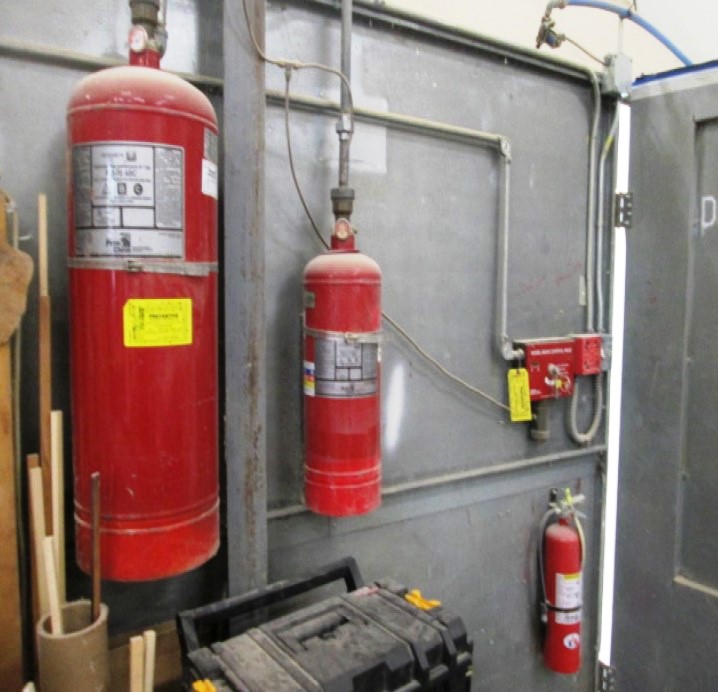
PHOTO SHOWS → FIXED DRY-CHEMICAL SUPPRESSION SYSTEM
→ Cylinders appear charged; piping intact; pull station labeled → System appears serviceable pending inspection
What You Are Looking At
- Pre-engineered dry chemical fire suppression system protecting a spray finishing/paint booth.
- Components include:
- Red dry-chemical cylinders (agent tanks + nitrogen driver cylinders)
- Distribution piping and discharge nozzles directed into the booth
- Manual pull station for system activation
- Detection tubing or mechanical fusible link triggers
- Portable ABC extinguisher nearby (required by NFPA 33)
- Designed for Class B (flammable liquids/solvents/paints) and Class C (electrical) ignition sources.
Why This Is a Serious Concern
- If the cylinders are low pressure, obstructed, or out of service, the fire can flash over rapidly due to paint vapors.
- Misaimed/blocked nozzles → the spray area may not be protected.
- Unlabeled or blocked pull station → delays activation during early-stage fire.
- Missing or expired semi-annual inspection tags violates NFPA 17A maintenance requirements.
A failed paint booth system can result in:
- rapid fire spread,
- toxic smoke,
- total building loss, and
- employee injury.
Good Condition (Acceptable)
- Cylinders fully charged: gauges in green/normal operating range.
- Piping and nozzles clean—free of overspray, dust, corrosion, or obstruction.
- Nozzles are correctly aimed into the booth hazard area per manufacturer spec.
- Manual pull station:
- clearly labeled,
- immediately accessible, and
- located along the path of egress.
- Current semi-annual service tags attached (NFPA 17A: systems must be inspected every 6 months).
- No visible leaks, rust, or mechanical damage.
Fix Needed – HIGH PRIORITY (Fire Suppression Failure Risk)
- Low pressure (gauge in yellow/red), damaged, or leaking cylinders.
- Piping or nozzles with corrosion, overspray buildup, or blockage.
- Pull station blocked, unlabeled, or inoperable.
- Expired or missing inspection/service tags (no semi-annual service record).
- Evidence of discharge, tampering, or disconnected detection tubing.
Corrective Actions & Proper Recommendation
Immediate
- Verify cylinder gauges for correct pressure.
- Clean visible overspray/dust from pipes and nozzles.
- Ensure manual pull station is unobstructed and clearly identified.
Within 7 Days
- Schedule licensed fire suppression technician for:
- semi-annual system inspection and functional checks (NFPA 17A §7.2),
- verification of detection and actuation components,
- nozzle alignment & pipe integrity check.
Within Required Testing Cycles
- Hydrostatic testing per cylinder manufacturer’s interval
(commonly 12 years for stored-pressure cylinders; verify tag/label). - Maintain required portable ABC extinguisher adjacent to booth per NFPA 33.
Report Wording Suggestions
“Good”
“Paint booth dry-chemical suppression system appears fully charged with clean nozzles, accessible pull station, and current semi-annual service tags.”
“Fix Needed – HIGH RISK”
“Paint booth fire suppression system shows low pressure/blocked nozzles/missing or expired service tags. Significant risk of failed activation in a fire. Remove obstructions, verify pressure today, and schedule licensed semi-annual service per NFPA 17A (2021).”
LCA Certified Inspector Motto
“Charge it. Clear it. Tag it. Rec it.”
Disclosure
This card highlights common deficiencies found in pre-engineered dry-chemical fire suppression systems for spray finishing operations. Requirements for inspection, testing, and repair vary by local fire code, AHJ (Authority Having Jurisdiction), system manufacturer specifications, and the edition of NFPA 17A and NFPA 33 adopted in the jurisdiction. Always verify local requirements and consult a licensed fire-suppression contractor when system condition, service history, or performance is in question.