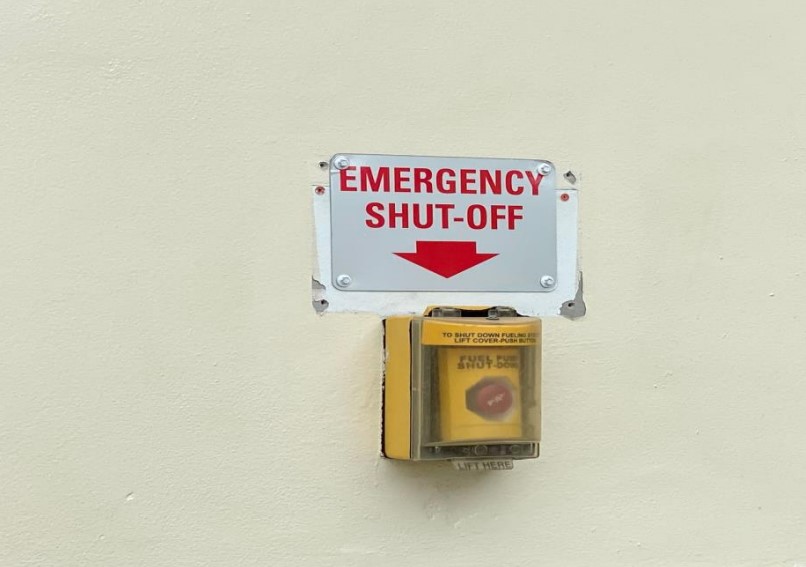
PHOTO SHOWS → PROPERLY INSTALLED FUEL SHUT-OFF
→ Clear signage • Readily accessible location • Protective cover (best practice) • Emergency-ready
What You Are Looking At
• Wall-mounted emergency electrical disconnect for fuel pumps (gas station, fleet yard, marina, etc.)
• Red emergency shut-off switch, often protected by a lift-up cover (cover is best practice, not code-required)
• Signage identifying the emergency shutoff device
Why This Is a Serious Concern
• Inaccessible or unclear shut-off = delayed response to fuel spill or fire
• OSHA requires a “clearly identified and easily accessible” means to shut off power to all dispensers
• NFPA 30A requires emergency shutoff devices located 20–100 ft from dispensers and clearly identified
• Failure to comply can result in enforcement actions by fire authorities and OSHA, and insurance complications after incidents
Good Condition (Acceptable)
NFPA 30A / OSHA Required:
• Sign clearly identifies the emergency shutoff
• Switch is readily accessible (not blocked, not hidden, no special tools needed)
• At least one shutoff device is located 20–100 ft from dispensers (NFPA 30A §6.7)
• Switch cuts power to all dispensing devices (OSHA 1910.106(g)(3)(iii), NFPA 30A §6.7)
• Reset requires manual action (NFPA/NFPA 70 references via 30A)
Best Practice (Not mandated, but recommended):
• Protective lift-up cover clean and operating freely
• Switch is mounted at an ergonomic height (commonly 42–48 in, but not required by code)
• Optional facility log shows periodic testing (NFPA/OSHA do not mandate monthly tests)
Fix Needed – HIGH PRIORITY (Fire/Spill Response Hazard)
Code Issues (NFPA/OSHA):
• Signage missing, unreadable, or not identifying the shutoff
• Switch blocked, obstructed, or otherwise not readily accessible
• Primary required shutoff not within 20–100 ft of the dispensers
• Shutoff does not disconnect all dispensing devices
Best-Practice / Condition Issues (Not code-mandated, but safety-critical):
• Protective cover stuck, cracked, locked, or missing
• Button painted over, damaged, or difficult to press
• Excessive clutter within arm’s reach that could delay activation
Corrective Actions & Proper Recommendation
1. Immediate – Code Compliance
• Install or replace clear signage marking the Emergency Fuel Shut-Off
• Remove obstructions so the switch is readily accessible
• Verify that the primary mandated shutoff is 20–100 ft from dispensers and cuts power to all systems
2. Within 7 Days – Strong Safety Enhancements (Best Practice)
• Add or replace protective cover if damaged
• If mounted at an unusual height causing access difficulty, relocate to an ergonomic height (not a code requirement)
• Maintain a 3-ft clear area around the switch for practical access (recommended)
3. Ongoing – Facility Policy / Best Practice
• Conduct periodic function checks (e.g., monthly or quarterly)
• Maintain a simple log per facility or AHJ preference
(NFPA/OSHA do not require periodic testing or logs, but many inspectors recommend them.)
• Schedule annual electrical inspection if required by local fire authority
Report Wording Suggestions
“Good” –
“Emergency fuel shutoff is clearly identified, readily accessible, and properly disconnects all dispensers. Signage intact and device operating normally.”
“Fix Needed – HIGH RISK” –
“Emergency fuel shutoff not clearly identified or not readily accessible. This can delay response during fire or spill. Recommend restoring required signage and access immediately and verifying proper disconnect per NFPA 30A §6.7 and OSHA 1910.106.”
LCA Certified Inspector Motto
“Sign it. Clear it. Test it (recommended). Rec it.”
Disclosure
This card separates code requirements (NFPA 30A, 2024 ed., Section 6.7; OSHA 29 CFR 1910.106) from recommended best practices. Always verify local fire codes and AHJ interpretations, which may impose additional requirements.